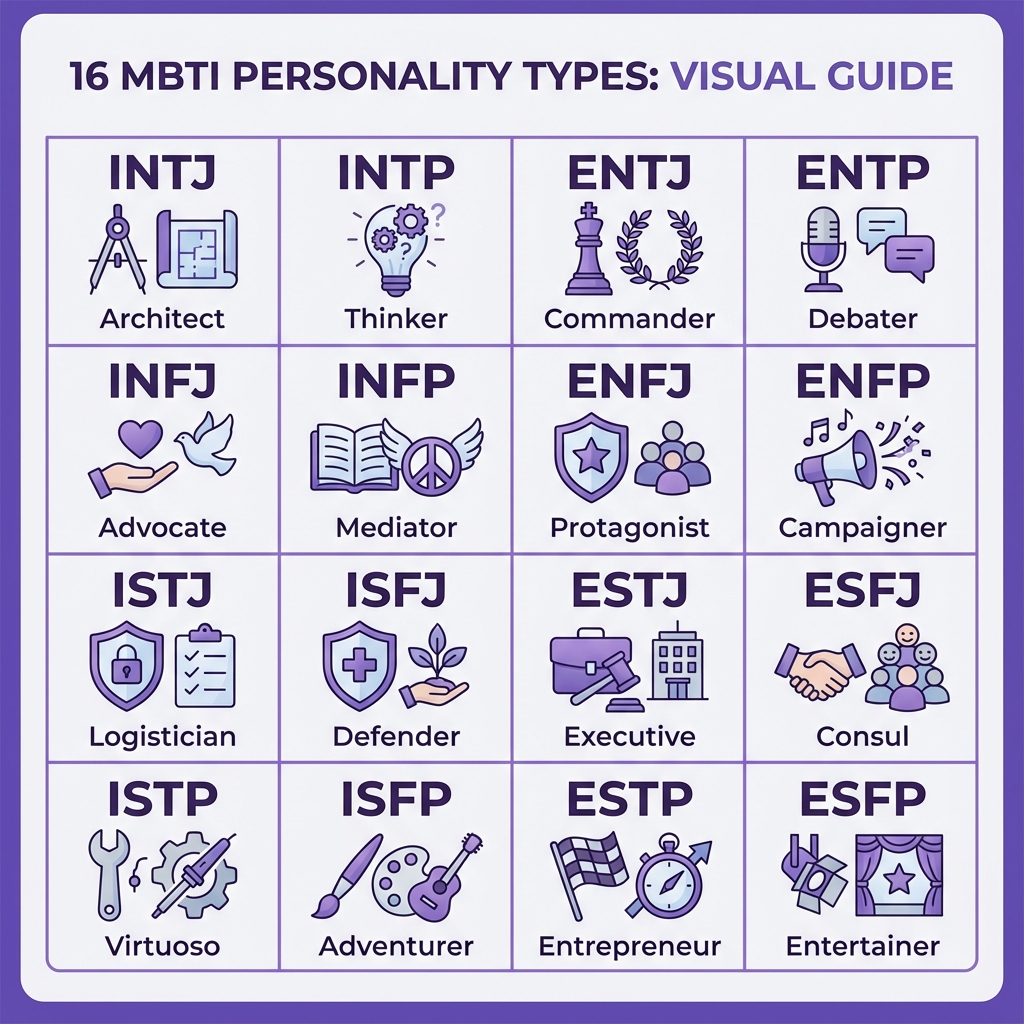
Understanding your personality type is one of the most powerful tools for personal growth. The Myers-Briggs Type Indicator (MBTI) identifies 16 distinct personality types, each with unique strengths, preferences, and ways of interacting with the world. In this comprehensive guide, we'll explore all 16 types and help you discover which one fits you best.
Quick Discovery
Want to find your type right now? Take our scientifically-validated personality assessment.
Take the Free Test →What is the Myers-Briggs Type Indicator (MBTI)?
The Myers-Briggs Type Indicator is a personality assessment developed by Katharine Cook Briggs and her daughter Isabel Briggs Myers, based on Carl Jung's theory of psychological types. Since its creation in the 1940s, the MBTI has become the world's most widely used personality assessment, taken by over 2 million people annually.
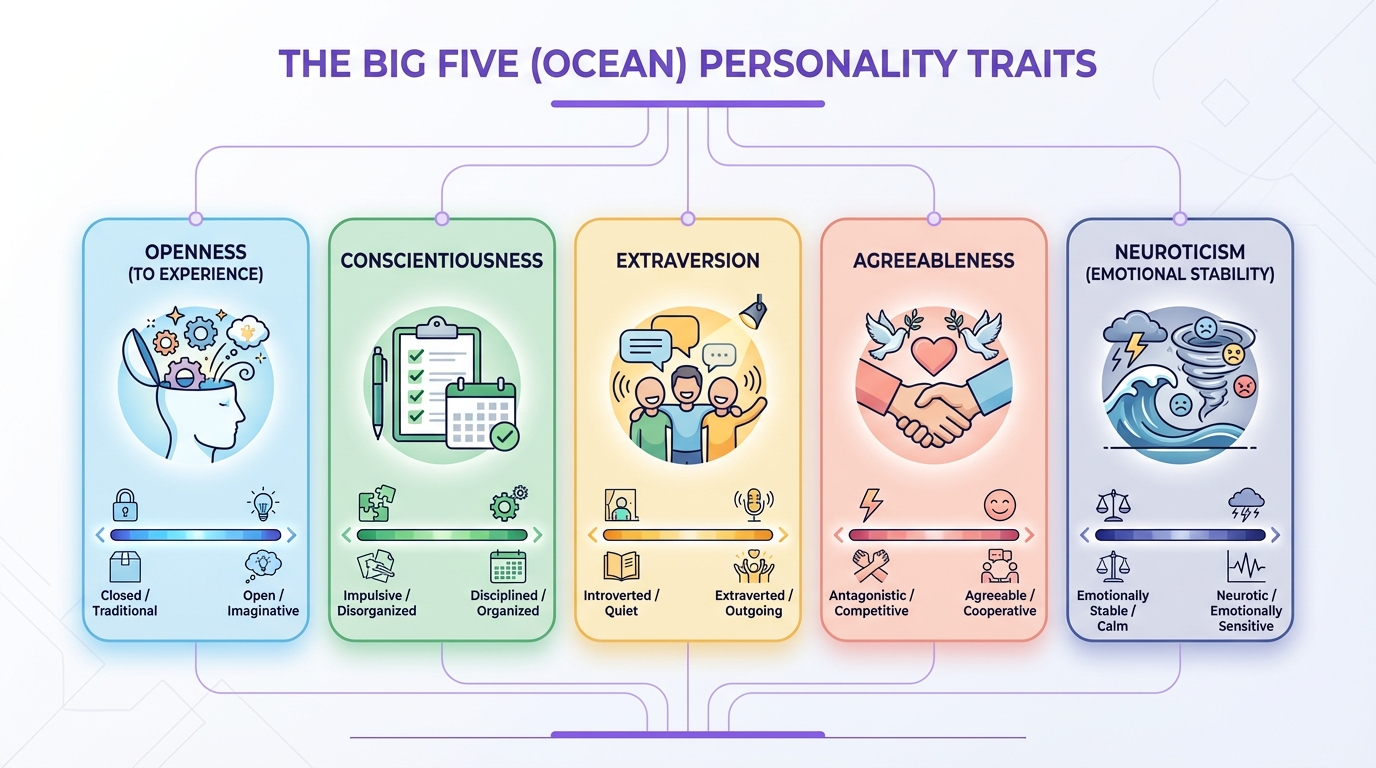
Unlike other personality frameworks like the Big Five model, the MBTI categorizes people into distinct types rather than measuring traits on a spectrum. This makes it particularly useful for understanding how different people perceive the world and make decisions.
The assessment measures preferences across four dichotomies, resulting in 16 possible personality type combinations. Each type is represented by a four-letter code (like INTJ or ENFP) that captures your dominant preferences in each dimension.
The Four Dimensions Explained
1. Extraversion (E) vs. Introversion (I)
This dimension describes where you direct your energy and how you recharge. Contrary to popular belief, this isn't about being shy or outgoing—it's about where you get your energy from.
Extraverts gain energy from external stimulation—social interaction, activities, and the outside world. They tend to think out loud, enjoy group settings, and feel energized after social events.
Introverts gain energy from internal reflection and solitude. They prefer deep one-on-one conversations, need time alone to recharge after social interaction, and often think before speaking. Learn more in our deep dive on introversion vs. extraversion.
2. Sensing (S) vs. Intuition (N)
This dimension describes how you take in information and what kind of data you naturally pay attention to.
Sensors focus on concrete, tangible information from their five senses. They trust experience, prefer practical applications, and pay attention to details and facts.
Intuitives focus on patterns, possibilities, and abstract concepts. They trust their gut instincts, enjoy theoretical discussions, and naturally see the big picture.
3. Thinking (T) vs. Feeling (F)
This dimension describes how you make decisions and evaluate information.
Thinkers prioritize logic, consistency, and objective criteria when making decisions. They value fairness, can separate emotions from analysis, and focus on cause and effect.
Feelers prioritize values, harmony, and how decisions affect people. They consider emotions important data, value empathy, and focus on maintaining relationships. This connects closely with emotional intelligence.
4. Judging (J) vs. Perceiving (P)
This dimension describes how you approach structure and the outside world.
Judgers prefer structure, planning, and closure. They like to have things decided, create schedules, and feel stressed by last-minute changes.
Perceivers prefer flexibility, spontaneity, and keeping options open. They adapt easily to new information, enjoy going with the flow, and may feel constrained by rigid plans.
The Analysts (NT Types)
Analyst types combine Intuition with Thinking, creating personalities driven by logic, strategy, and intellectual exploration. They represent approximately 10% of the population.
INTJ - The Architect
INTJs are strategic masterminds who see the world as a giant chess board. They're known for their ability to develop complex long-term plans and their relentless pursuit of competence. Famous INTJs include Elon Musk, Michelle Obama, and Christopher Nolan.
Strengths: Strategic thinking, independence, determination, high standards
Challenges: Can be overly critical, dismissive of emotions, difficulty relaxing
Best careers: Software architect, scientist, investment strategist, surgeon
INTP - The Logician
INTPs are innovative thinkers who love to analyze systems and find logical inconsistencies. They're often described as "walking encyclopedias" due to their vast knowledge across many subjects.
Strengths: Analytical brilliance, objectivity, imagination, originality
Challenges: Can overthink, insensitive to emotions, dislike routine
Best careers: Software developer, research scientist, mathematician, philosopher
ENTJ - The Commander
ENTJs are natural-born leaders who embody confidence and authority. They excel at organizing people and resources to achieve ambitious goals.
Strengths: Efficient leadership, self-confidence, strategic vision, determination
Challenges: Can be domineering, impatient, intolerant of inefficiency
Best careers: CEO, entrepreneur, lawyer, management consultant
ENTP - The Debater
ENTPs are quick-witted innovators who love intellectual sparring and challenging assumptions. They see every interaction as an opportunity to learn something new.
Strengths: Quick thinking, charisma, originality, excellent brainstormers
Challenges: Can be argumentative, insensitive, dislike practical matters
Best careers: Entrepreneur, lawyer, creative director, consultant
The Diplomats (NF Types)
Diplomat types combine Intuition with Feeling, creating empathetic idealists driven by their values and desire to help others. They make up approximately 15% of the population.
INFJ - The Advocate
INFJs are the rarest personality type, making up only 1-2% of the population. They combine deep empathy with strategic thinking, often becoming passionate advocates for causes they believe in. Their attachment style often influences their intense approach to relationships.
Strengths: Insightful, principled, passionate, altruistic
Challenges: Perfectionist, can burn out, extremely private
Best careers: Counselor, writer, human rights advocate, psychologist
INFP - The Mediator
INFPs are imaginative idealists guided by their own core values and beliefs. They see the potential in everyone and are always looking for the good.
Strengths: Empathetic, creative, open-minded, passionate
Challenges: Overly idealistic, self-critical, impractical
Best careers: Writer, artist, counselor, teacher, social worker
ENFJ - The Protagonist
ENFJs are charismatic leaders who inspire others to achieve their potential. They have an uncanny ability to sense what motivates people and bring out their best.
Strengths: Natural leadership, charismatic, reliable, altruistic
Challenges: Overly idealistic, too selfless, sensitive to criticism
Best careers: Teacher, HR manager, politician, life coach
ENFP - The Campaigner
ENFPs are enthusiastic, creative, and free-spirited individuals who find meaning in connecting with others. They're often described as the "most introverted extraverts."
Strengths: Curious, energetic, excellent communicators, perceptive
Challenges: Unfocused, overthink, highly emotional, people-pleasing
Best careers: Journalist, actor, consultant, entrepreneur, counselor
Which Diplomat Type Are You?
These empathetic idealists make up 15% of the population. Discover if you're an INFJ, INFP, ENFJ, or ENFP.
Find Your Type →The Sentinels (SJ Types)
Sentinel types combine Sensing with Judging, creating practical, reliable individuals who value tradition and stability. They represent approximately 40% of the population.
ISTJ - The Logistician
ISTJs are dependable, thorough, and responsible. They honor their commitments and take pride in doing things right the first time.
Strengths: Honest, direct, dutiful, responsible, calm under pressure
Challenges: Stubborn, insensitive, always by the book
Best careers: Accountant, lawyer, military officer, project manager
ISFJ - The Defender
ISFJs are nurturing protectors who take care of those around them with quiet dedication. They remember details about people and use this knowledge to support others.
Strengths: Supportive, reliable, patient, observant, loyal
Challenges: Humble to a fault, reluctant to change, overloaded
Best careers: Nurse, teacher, social worker, administrator
ESTJ - The Executive
ESTJs are organized, logical, and assertive. They represent order and tradition, taking charge to ensure things are done correctly.
Strengths: Dedicated, strong-willed, direct, honest, loyal
Challenges: Inflexible, uncomfortable with unconventional situations
Best careers: Manager, judge, financial officer, military leader
ESFJ - The Consul
ESFJs are caring, social, and traditional. They want to help others and bring people together, often serving as the social glue in groups.
Strengths: Strong practical skills, loyal, sensitive, warm
Challenges: Worried about social status, inflexible, reluctant to improvise
Best careers: Healthcare worker, teacher, event planner, HR manager
Are You a Sentinel?
Sentinels are the most common type, making up 40% of the population. They're the reliable backbone of organizations.
Take the Quiz →The Explorers (SP Types)
Explorer types combine Sensing with Perceiving, creating flexible, practical individuals who live in the moment. They make up approximately 35% of the population.
ISTP - The Virtuoso
ISTPs are bold, practical experimenters who love to take things apart and put them back together. They're natural troubleshooters with great technical skills.
Strengths: Optimistic, creative, practical, relaxed, priortizes well
Challenges: Stubborn, insensitive, private, easily bored
Best careers: Engineer, mechanic, pilot, forensic scientist
ISFP - The Adventurer
ISFPs are gentle caretakers who live in the present moment. They're artistic, sensitive, and fiercely independent.
Strengths: Charming, sensitive to others, imaginative, passionate
Challenges: Fiercely independent, unpredictable, easily stressed
Best careers: Artist, musician, designer, veterinarian, chef
ESTP - The Entrepreneur
ESTPs are energetic thrill-seekers who live life on the edge. They're perceptive, direct, and always where the action is.
Strengths: Bold, rational, perceptive, direct, sociable
Challenges: Insensitive, impatient, risk-prone, unstructured
Best careers: Entrepreneur, paramedic, detective, sales
ESFP - The Entertainer
ESFPs are spontaneous, energetic, and fun-loving. They love being the center of attention and bringing joy to others.
Strengths: Bold, original, practical, observant, excellent people skills
Challenges: Sensitive, conflict-averse, easily bored, poor long-term focus
Best careers: Actor, event planner, sales rep, tour guide, flight attendant
Finding Your True Type
While online tests can give you a starting point, finding your true type requires honest self-reflection. Here are some tips:
- Focus on your natural preferences - Think about what you do when you're not trying to meet external expectations
- Consider your childhood - Your type is innate, so think about your tendencies before social pressures shaped your behavior
- Look at cognitive functions - Each type has a unique stack of cognitive functions that goes deeper than the four letters
- Read type descriptions carefully - See which one resonates most deeply, not which one you aspire to be
Ready to Discover Your Type?
Our comprehensive personality assessment analyzes your responses across multiple dimensions to determine your most likely type.
Take the Free Assessment →How Personality Types Interact
Understanding type dynamics can improve your relationships significantly. Some key patterns:
- NT + NF combinations often create intellectually stimulating relationships with emotional depth
- SP + SJ pairings can balance each other's need for stability and spontaneity
- Same-type relationships offer easy understanding but may lack growth challenges
- Opposite types (like INTJ/ESFP) can either create powerful complementarity or significant friction
Your personality type also influences your love language preferences and attachment patterns.
Frequently Asked Questions
Can your personality type change over time?
Your core type remains stable throughout life, though you may develop and strengthen your less-preferred functions as you mature. What often changes is how well you've developed each aspect of your type, not the type itself.
Is one personality type better than others?
Absolutely not. Each type has unique strengths and challenges. Success, happiness, and fulfillment are possible for all types—what matters is understanding and leveraging your natural preferences.
Why do I get different results on different tests?
Test results can vary based on your mood, the quality of the test, and how honestly you answer. If you consistently score near the middle on any dimension, you might be close to the dividing line. Focus on which type description resonates most deeply.
How accurate is the MBTI?
The MBTI has mixed scientific support. While it's useful for self-reflection and understanding preferences, it shouldn't be used for hiring decisions or as a definitive measure of capability. The Big Five model has stronger empirical support.
Conclusion
Understanding your personality type is a journey of self-discovery that can improve your relationships, career satisfaction, and personal growth. Whether you're an analytical INTJ, an empathetic INFJ, or an adventurous ESTP, embracing your natural preferences while developing your less-preferred functions is the key to becoming a well-rounded individual.
Remember that your type is a starting point for understanding yourself—not a box that limits who you can become. Use this knowledge as a tool for growth, not an excuse for stagnation.
Discover Your Personality Type
Join over 5 million people who have taken our comprehensive personality assessment
Start the Free Test →