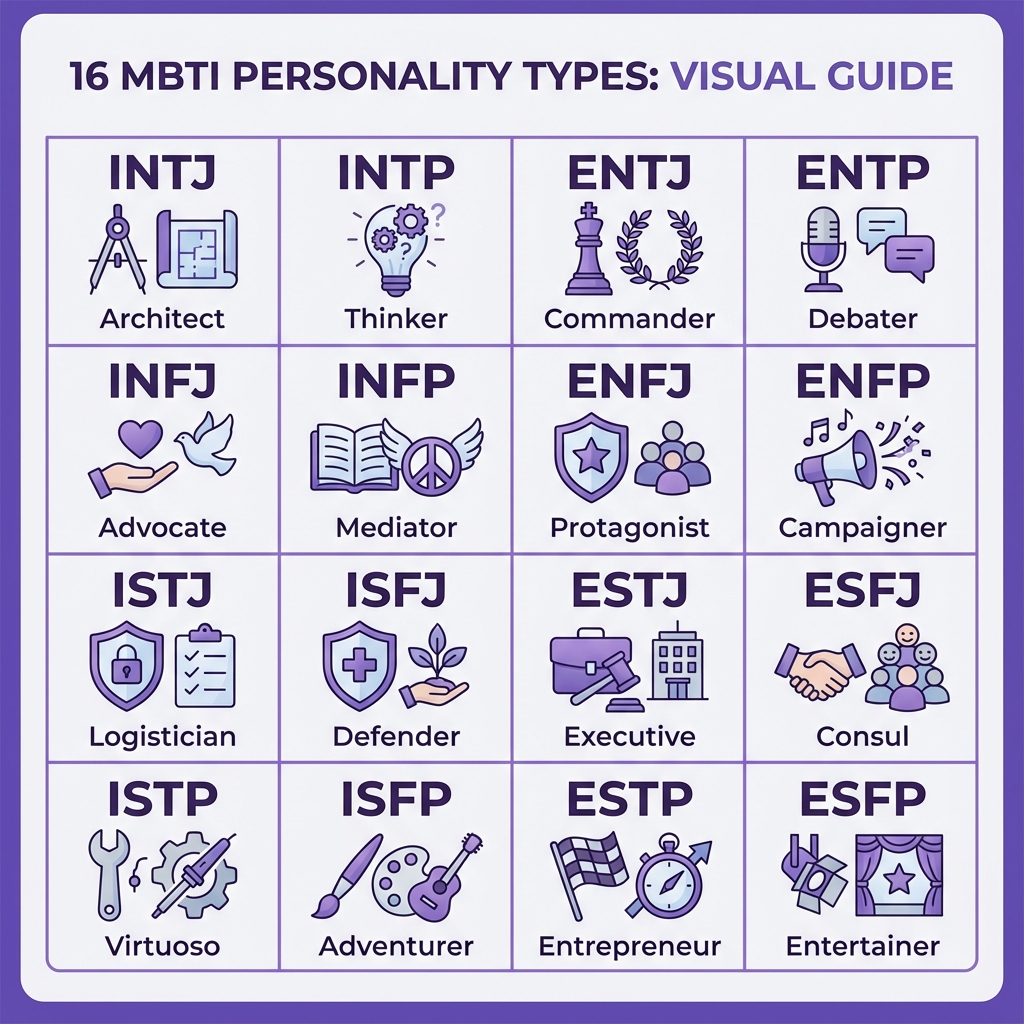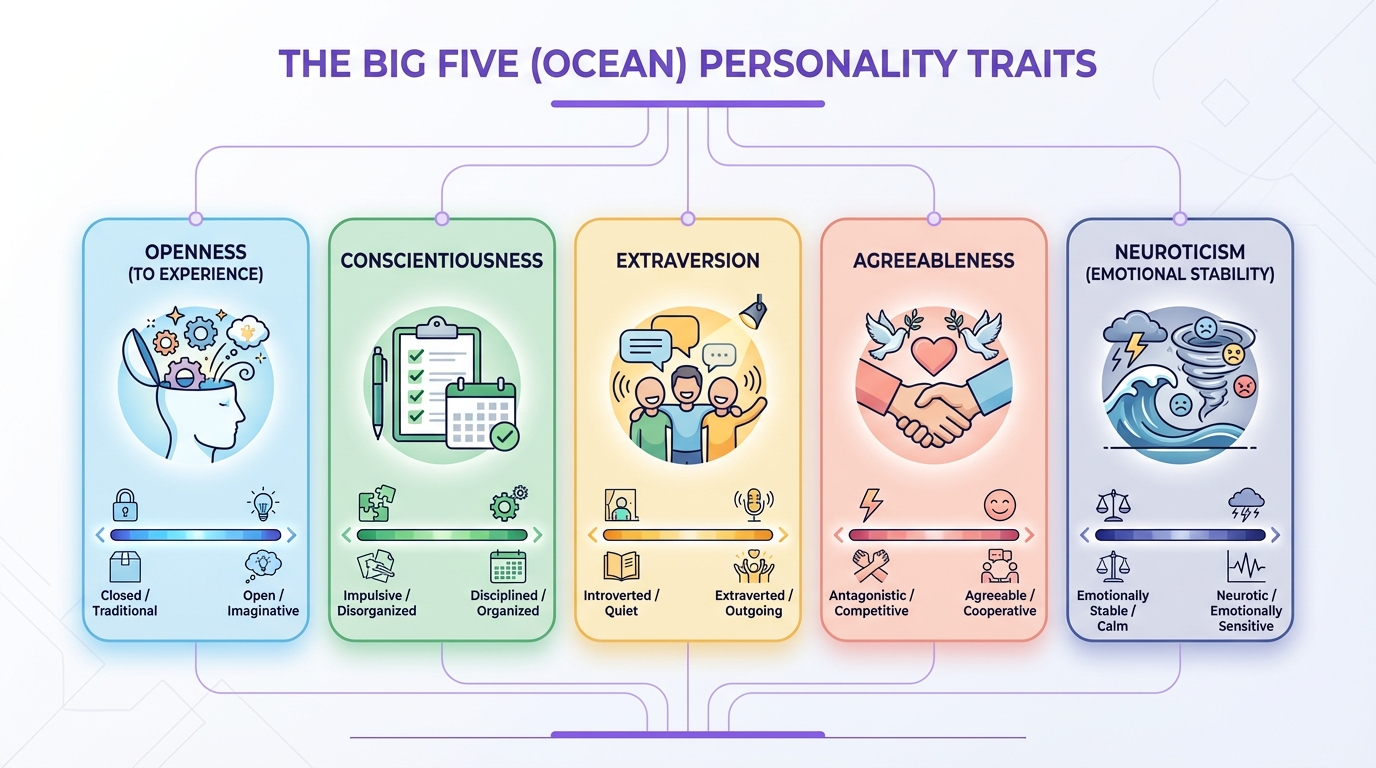
While the MBTI is popular, the Big Five (also known as OCEAN or the Five-Factor Model) is the most scientifically validated personality framework. Used by researchers worldwide, it measures five broad dimensions that capture the essential ways humans differ from each other. Understanding your Big Five profile can provide powerful insights into your behavior, relationships, and life outcomes.
Measure Your Big Five
Get your scientifically-validated Big Five personality profile with our comprehensive assessment.
Take the Assessment →What Are the Big Five Personality Traits?
The Big Five model emerged from decades of research using factor analysis—a statistical method that identifies patterns in large datasets. Researchers found that thousands of personality-describing words consistently cluster into five broad factors, suggesting these are fundamental dimensions of human personality.
Unlike type-based systems that categorize people (like MBTI), the Big Five measures where you fall on a spectrum for each trait. You're not "an extrovert" or "an introvert"—you have a certain level of extraversion that can be measured and compared.
The acronym OCEAN helps remember the five traits:
Openness
Conscientiousness
Extraversion
Agreeableness
Neuroticism
Openness to Experience
Openness reflects your appetite for novelty, creativity, and intellectual curiosity. It's the trait most associated with creativity and artistic expression.
High Openness Characteristics
- Curious about new ideas and experiences
- Appreciates art, beauty, and imagination
- Enjoys abstract thinking and philosophical discussions
- Open to unconventional ideas and lifestyles
- Seeks variety and novelty
Low Openness Characteristics
- Prefers routine and familiarity
- More practical and concrete in thinking
- Traditional in values and beliefs
- Comfortable with the status quo
- Focused on proven methods
Openness and Life Outcomes
High openness is associated with creativity, artistic achievement, and liberal political views. However, very high openness can sometimes lead to impracticality or difficulty making decisions. Low openness individuals often excel in structured environments that reward consistency and specialization.
Conscientiousness
Conscientiousness is your tendency toward self-discipline, organization, and goal-directed behavior. It's the single best personality predictor of academic and career success.
High Conscientiousness Characteristics
- Organized and detail-oriented
- Self-disciplined and reliable
- Plans ahead and follows through
- Strong sense of duty and responsibility
- Achievement-oriented
Low Conscientiousness Characteristics
- Spontaneous and flexible
- May struggle with deadlines and organization
- Prefers to keep options open
- More laid-back about rules and structure
- Can be easily distracted
Conscientiousness and Life Outcomes
Research consistently shows that conscientiousness predicts:
- Higher academic achievement at all levels
- Greater career success and income
- Better health and longevity
- Lower rates of substance abuse
- More stable relationships
The good news? Conscientiousness tends to increase naturally as we age, and deliberate effort to build habits can raise it further.
Extraversion
Extraversion reflects your orientation toward the external world, social engagement, and positive emotions. We covered this in depth in our article on introversion versus extraversion.
High Extraversion Characteristics
- Energized by social interaction
- Talkative and assertive
- Experiences frequent positive emotions
- Seeks excitement and stimulation
- Comfortable in groups and as center of attention
Low Extraversion (Introversion) Characteristics
- Energized by solitude and reflection
- Quiet and reserved in groups
- Prefers depth over breadth in relationships
- Less need for external stimulation
- More even emotional tone
Extraversion and Life Outcomes
Extraverts tend to report higher levels of happiness and positive emotions. They often excel in sales, leadership, and social professions. However, introverts have advantages in roles requiring focus, writing, and independent work. Neither extreme is inherently better—it depends on the context.
Agreeableness
Agreeableness reflects your interpersonal style—whether you tend to be cooperative and trusting or competitive and skeptical. It strongly influences relationship quality and conflict resolution.
High Agreeableness Characteristics
- Cooperative and trusting
- Empathetic and compassionate
- Avoids conflict and confrontation
- Helpful and accommodating
- Assumes positive intent in others
Low Agreeableness Characteristics
- Competitive and challenging
- Skeptical and questioning
- Direct and willing to confront
- Prioritizes personal interests
- Less swayed by social pressure
Agreeableness and Life Outcomes
High agreeableness predicts better relationships and is associated with helping professions. However, very high agreeableness can lead to being taken advantage of and difficulty asserting boundaries. Low agreeableness individuals often excel in competitive environments and roles requiring tough decisions. Understanding your agreeableness helps you navigate relationship dynamics more effectively.
Neuroticism (Emotional Stability)
Neuroticism reflects your tendency to experience negative emotions like anxiety, sadness, and irritability. Some frameworks flip this and call it "Emotional Stability" (where high scores mean less neurotic).
High Neuroticism Characteristics
- Experiences frequent negative emotions
- Sensitive to stress and criticism
- Prone to worry and anxiety
- Mood can be unpredictable
- May ruminate on problems
Low Neuroticism (High Emotional Stability) Characteristics
- Calm and emotionally stable
- Resilient under stress
- Even-tempered
- Quick to recover from setbacks
- Less reactive to negative events
Neuroticism and Life Outcomes
High neuroticism is associated with higher rates of anxiety, depression, and relationship difficulties. However, moderate levels can increase vigilance and preparation for real threats. Developing emotional intelligence can help manage the challenges of high neuroticism.
Get Your Big Five Profile
Discover where you score on each of the five dimensions with our comprehensive personality assessment.
Start the Assessment →How Big Five Predicts Life Outcomes
Decades of research have established clear links between Big Five traits and life outcomes:
| Outcome | Strongest Predictors |
|---|---|
| Academic Success | High Conscientiousness, High Openness |
| Career Success | High Conscientiousness, Low Neuroticism |
| Leadership | High Extraversion, High Conscientiousness |
| Relationship Satisfaction | High Agreeableness, Low Neuroticism |
| Health & Longevity | High Conscientiousness, Low Neuroticism |
| Creativity | High Openness |
| Happiness | High Extraversion, Low Neuroticism |
Can You Change Your Personality?
Yes, but it takes effort. Research shows that personality traits are about 50% heritable and 50% shaped by environment and experience. Key findings include:
- Natural change: Conscientiousness and agreeableness tend to increase with age, while neuroticism decreases
- Intentional change: Studies show people can deliberately change traits by consistently acting in desired ways
- Therapy effects: Psychotherapy can significantly reduce neuroticism and increase extraversion
- Life experiences: Major life events (marriage, career success, parenting) can shift traits
The key is sustained effort over time. Small, consistent behaviors compound into trait-level changes.
Discover Your Big Five Profile
Our comprehensive assessment measures your position on all five dimensions with detailed insights.
Take the Assessment →Big Five vs. MBTI: Which is Better?
Both have their place:
Big Five advantages:
- More scientifically validated
- Better predicts real-world outcomes
- Measures traits on a spectrum (more nuanced)
- Preferred by researchers
MBTI advantages:
- Easier to understand and remember
- Creates a sense of identity and community
- Better for self-reflection and team building
- More widely known and discussed
For scientific accuracy, choose the Big Five. For self-discovery and discussion, the MBTI has value too.
Conclusion
The Big Five provides the most scientifically rigorous framework for understanding personality. Knowing where you stand on these five dimensions can help you understand your strengths and challenges, make better decisions about career and relationships, and focus your personal development efforts where they'll matter most.
Remember: your traits are tendencies, not destiny. Understanding them is the first step toward working with your nature rather than against it.
Get Your Big Five Profile
Take our comprehensive assessment and receive detailed insights into your personality
Start the Assessment →