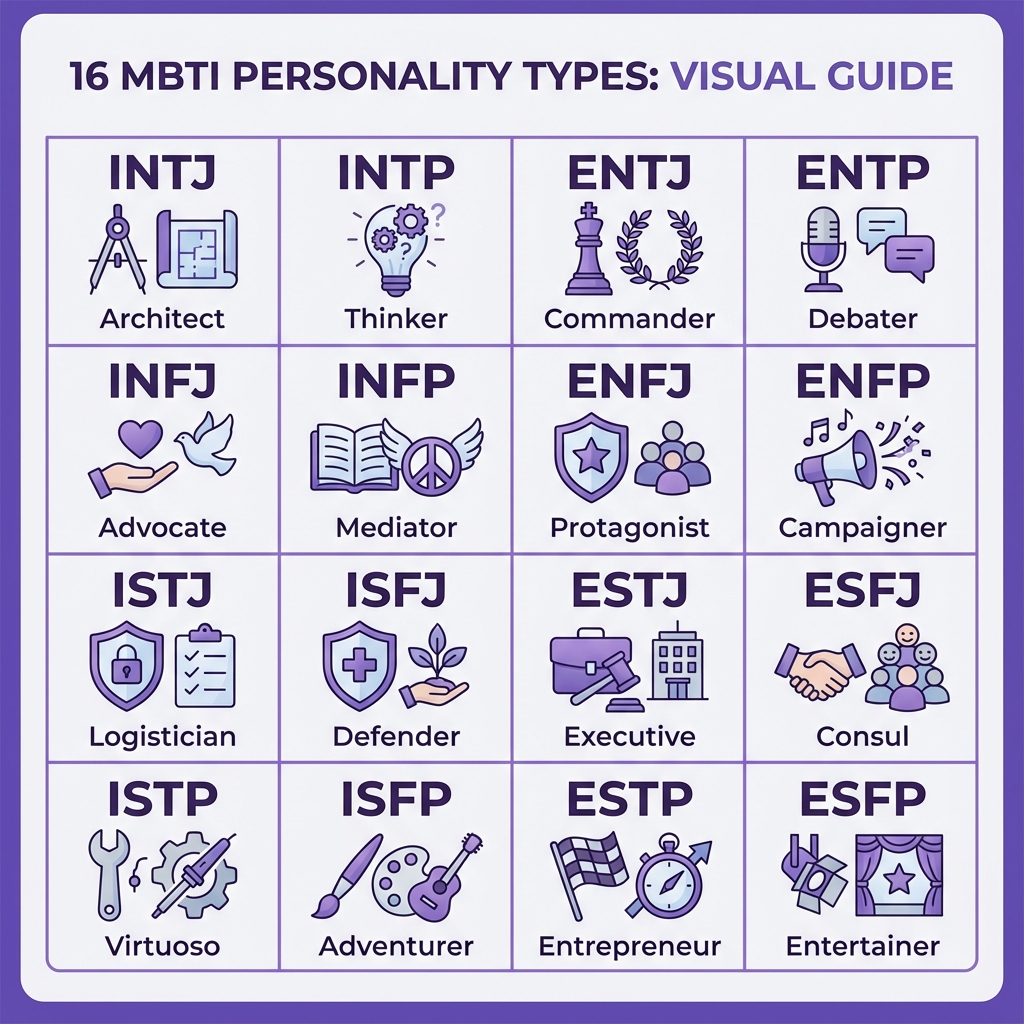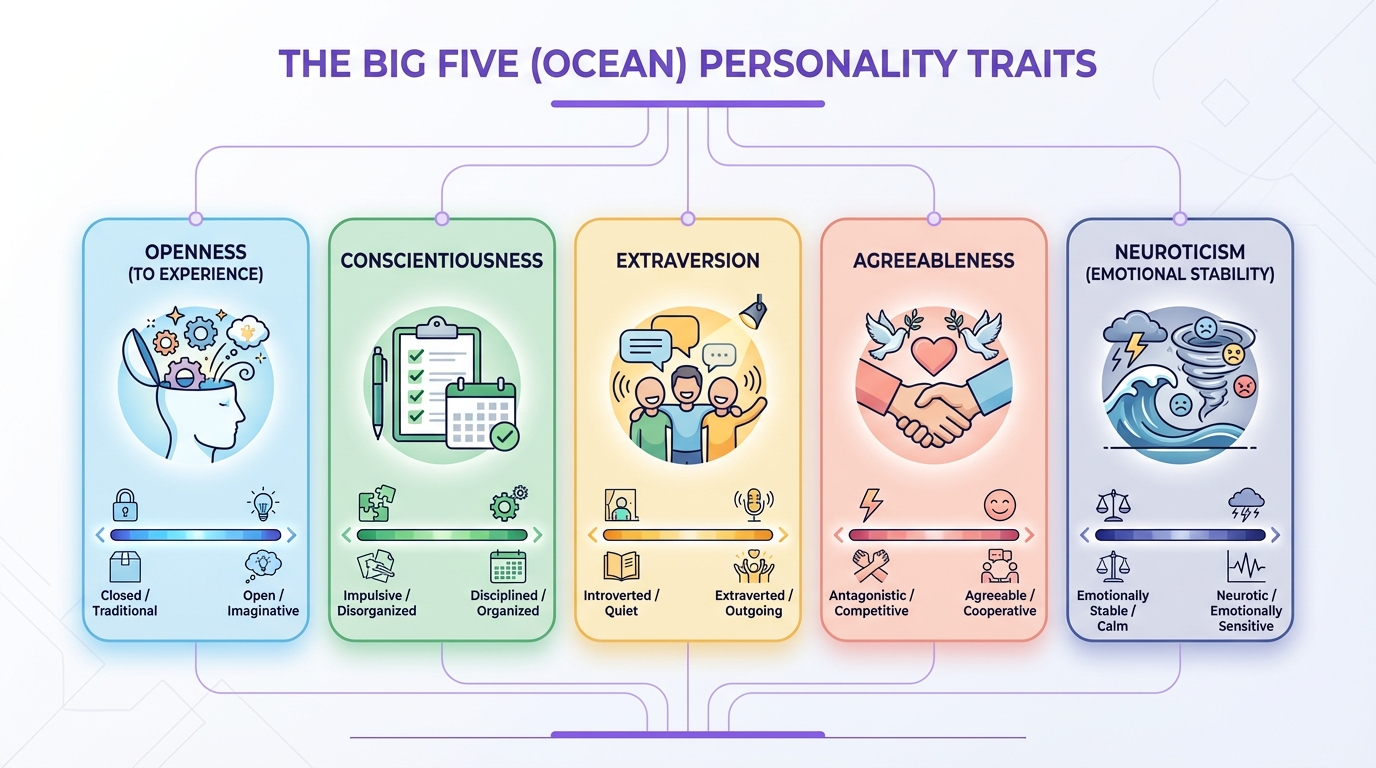
The Myers-Briggs Type Indicator (MBTI) is the world's most popular personality assessment, taken by over 2 million people annually. This comprehensive guide will help you understand all 16 personality types and discover which one describes you best.
What is the MBTI?
The Myers-Briggs Type Indicator (MBTI) is a personality assessment developed by Isabel Briggs Myers and her mother, Katharine Cook Briggs, based on the psychological theories of Carl Jung. First published in 1962, it has become the most widely used personality assessment tool in the world.
Unlike other personality tests that measure traits on a spectrum, the MBTI categorizes people into one of 16 distinct personality types. Each type is represented by a four-letter code that indicates your preferences in four key areas of personality.
Important: The MBTI is designed to help you understand yourself better, not to put you in a box. Your type describes your natural preferences, not your abilities or limitations.

The Four Dimensions Explained
The MBTI measures your preferences across four fundamental dimensions. Understanding these dimensions is key to understanding your personality type.
1. Extraversion (E) vs. Introversion (I)
Where do you get your energy?
Extraverts (E) are energized by interaction with the outside world. They tend to:
- Think out loud and process information through discussion
- Enjoy being around people and social activities
- Act first, then reflect
- Have a wide circle of friends and acquaintances
Introverts (I) are energized by their inner world of ideas and reflection. They tend to:
- Think deeply before speaking
- Need alone time to recharge after social interaction
- Reflect first, then act
- Prefer deep conversations with a few close friends
2. Sensing (S) vs. Intuition (N)
How do you take in information?
Sensors (S) focus on concrete, practical information. They tend to:
- Trust information that is tangible and verifiable
- Focus on facts, details, and present realities
- Learn best through hands-on experience
- Value practical applications
Intuitives (N) focus on patterns, possibilities, and meanings. They tend to:
- See the big picture and future possibilities
- Focus on patterns, theories, and abstract concepts
- Trust their hunches and insights
- Value innovation and imagination
3. Thinking (T) vs. Feeling (F)
How do you make decisions?
Thinkers (T) make decisions based on objective logic. They tend to:
- Analyze pros and cons objectively
- Value fairness and consistency in principles
- Give honest, direct feedback
- May appear detached or impersonal
Feelers (F) make decisions based on values and impact on people. They tend to:
- Consider how decisions affect people's feelings
- Value harmony and compassion
- Give tactful, supportive feedback
- May appear overly emotional or subjective
4. Judging (J) vs. Perceiving (P)
How do you approach the outside world?
Judgers (J) prefer structure and decisiveness. They tend to:
- Like having things settled and organized
- Make plans and stick to them
- Work steadily toward deadlines
- Feel stressed by last-minute changes
Perceivers (P) prefer flexibility and spontaneity. They tend to:
- Like keeping options open
- Adapt easily to changing circumstances
- Work in bursts of energy close to deadlines
- Feel confined by rigid schedules

All 16 Personality Types
These four dimensions combine to create 16 unique personality types. Each type has its own strengths, challenges, and characteristic behaviors.
Take our free 16 Personalities quiz to discover your type in 10 minutes.
The Analysts (NT Types)
Analysts combine Intuition with Thinking. They are strategic, innovative, and focused on competence.
| Type | Name | Key Traits | Famous Examples |
|---|---|---|---|
| INTJ | The Architect | Strategic, independent, determined, ambitious | Elon Musk, Michelle Obama |
| INTP | The Logician | Analytical, objective, reserved, flexible | Albert Einstein, Bill Gates |
| ENTJ | The Commander | Bold, decisive, confident, natural leaders | Steve Jobs, Margaret Thatcher |
| ENTP | The Debater | Smart, curious, intellectually challenging | Mark Twain, Tom Hanks |
The Diplomats (NF Types)
Diplomats combine Intuition with Feeling. They are empathetic, idealistic, and focused on personal growth.
| Type | Name | Key Traits | Famous Examples |
|---|---|---|---|
| INFJ | The Advocate | Insightful, principled, compassionate, private | Martin Luther King Jr., Nelson Mandela |
| INFP | The Mediator | Idealistic, empathetic, creative, reserved | William Shakespeare, Princess Diana |
| ENFJ | The Protagonist | Charismatic, inspiring, natural teachers | Barack Obama, Oprah Winfrey |
| ENFP | The Campaigner | Enthusiastic, creative, sociable, optimistic | Robin Williams, Walt Disney |
The Sentinels (SJ Types)
Sentinels combine Sensing with Judging. They are practical, reliable, and focused on duty and tradition.
| Type | Name | Key Traits | Famous Examples |
|---|---|---|---|
| ISTJ | The Logistician | Responsible, sincere, practical, analytical | George Washington, Warren Buffett |
| ISFJ | The Defender | Supportive, reliable, patient, observant | Mother Teresa, Beyoncé |
| ESTJ | The Executive | Organized, logical, assertive, dedicated | Henry Ford, Sonia Sotomayor |
| ESFJ | The Consul | Caring, sociable, traditional, loyal | Taylor Swift, Bill Clinton |
The Explorers (SP Types)
Explorers combine Sensing with Perceiving. They are spontaneous, energetic, and focused on the present moment.
| Type | Name | Key Traits | Famous Examples |
|---|---|---|---|
| ISTP | The Virtuoso | Bold, practical, experimental, hands-on | Michael Jordan, Clint Eastwood |
| ISFP | The Adventurer | Flexible, charming, artistic, sensitive | Michael Jackson, Marilyn Monroe |
| ESTP | The Entrepreneur | Smart, energetic, perceptive, risk-takers | Donald Trump, Madonna |
| ESFP | The Entertainer | Spontaneous, energetic, friendly, playful | Adele, Jamie Oliver |
How to Find Your Type
There are several ways to discover your MBTI personality type:
- Take an official assessment - The official MBTI assessment is administered by certified practitioners. While it's the most accurate, it can be costly.
- Take a free online test - Our 16 Personalities Quiz provides a reliable approximation of your type in just 10 minutes.
- Self-type through study - Read about each preference and each type in depth, then determine which descriptions resonate most with you.
- Work with a coach - A trained MBTI practitioner can help you identify your type through guided questions and discussion.
Tip: Don't rely solely on online tests. The best way to confirm your type is to study the cognitive functions and see which type description truly fits how your mind works.

Career Paths by Type
Understanding your personality type can help you choose a career that aligns with your natural strengths and preferences.
- INTJ/ENTJ: Executive, entrepreneur, strategic planner, investment banker
- INTP/ENTP: Scientist, software developer, architect, consultant
- INFJ/ENFJ: Counselor, teacher, HR manager, non-profit director
- INFP/ENFP: Writer, therapist, graphic designer, marketing creative
- ISTJ/ESTJ: Accountant, project manager, military officer, judge
- ISFJ/ESFJ: Nurse, social worker, office manager, veterinarian
- ISTP/ESTP: Engineer, paramedic, pilot, sales representative
- ISFP/ESFP: Artist, musician, fitness trainer, event planner
Relationship Compatibility
While any two types can have a successful relationship, some pairings tend to be more naturally compatible. Generally:
- Best matches often share the same middle two letters (ST, SF, NT, or NF) or have complementary differences
- Opposites attract but require more effort to understand each other
- Communication style differences (T vs F) are often the biggest challenge
Remember: Compatibility is about more than just type. Emotional maturity, shared values, and communication skills matter far more than having the "right" type combination.
Frequently Asked Questions
Can your MBTI type change over time?
Your core type is believed to be innate and stable throughout your life. However, you may develop skills in your non-preferred areas as you mature, making you appear more balanced. Additionally, stress can cause you to behave out of character.
Is the MBTI scientifically valid?
The MBTI has been criticized by some academics for lack of empirical support and poor test-retest reliability. However, millions of people find it useful for self-understanding and personal development. It's best viewed as a tool for reflection rather than a scientific diagnostic instrument.
What's the rarest MBTI type?
INFJ is often cited as the rarest type, making up only 1-3% of the population. INTJ and ENTJ are also relatively rare. The most common types are ISFJ and ESFJ.
Can two people of the same type be very different?
Absolutely! Your MBTI type describes your cognitive preferences, not your behavior, values, intelligence, or life experiences. Two INFJs can be quite different depending on their upbringing, culture, and personal development.
Ready to Discover Your Type?
Take our free 16 Personalities Quiz and get your detailed personality profile in just 10 minutes.
Take the Free Quiz